Feeds:
Posts
Comments

Archive for the ‘fiction authors’ Category

Girl looking out window

It’s strange the way things pan out in life. My career as a writer almost didn’t happen.

I was in 3rd grade in primary school, slowly getting on top of things, when we were sent home one day with instructions to write our first composition.

I trudged home, very unhappy. My career as an even halfway-coping schoolkid was over. I knew I’d never be able to write a composition.

My mother was in the kitchen, preparing the evening meal. Unusual for him, my father was also home; there’d been very few ships in port that day. When he saw me slumped in misery at the kitchen table, he asked me what was wrong.

I said, “We have to write a composition about trees, and I can’t write compositions.” and I began to cry.

My father put down his newspaper and said, “It’s okay. Whatever the subject is, you just talk about it.”

“Talk about it?” I wailed.

“Yeah,” he said, “like how they’re green and leafy and they give people shade. Do you like trees?”

Of course I liked trees. I practically lived in the loquat tree up the back.

“Have a go,” said my father, returning to his paper.

I sat there, chewing the end of my pencil, and tried to write as if I was talking about trees. That half-page took me the best part of an hour.

“How’d it go?” said my father, who must’ve been watching my progress from behind his paper. He read through what I’d written. “Not bad,” he said. “But it needs something.” And he dictated a line about leaves dancing when the wind blew; something quite poetic. “Slip that in somewhere,” he said.

I rewrote the piece, placing the line he’d dictated where, I hoped, a teacher was least likely to notice the extra zing it put into my dreary effort.


By the time the English teacher came into the room carrying our exercise books three days later, I very much regretted using the line my father had written. Now, it was all too late, as she began to deal with each composition in turn, from worst to best — a tried and tested form of torture even when your conscience is clear, and mine certainly wasn’t. Eventually, there were no exercise books left but mine. I was convinced she’d saved mine ‘til last because she intended to expose me before the whole class. Why had I let my father talk me into adding that line about leaves in the breeze?

To my surprise, she pronounced my composition the best, and read it out to the class. I felt no elation, though it was the first time I’d ever come first in anything. How, I asked myself, was I going to continue this run? My father was leaving in a few days for a job at sea. What on earth was I going to do?

Inevitably, we were given a new subject to write about. I trudged home and sat at the kitchen table. Nothing came. I felt like the girl in the fairy tale who was supposed to spin straw into gold. Or else.

In desperation, I decided I’d pretend to be my father. Clearly, I had no talent for writing, but he did. Okay, Dad, I said to myself, what have you got to say about pets? And I began to write.

I was stunned when that composition also came first. Around me, there were boys in tears, boys who hadn’t been able to get even four lines onto the pages of their exercise books.

I knew how they felt.

It was pure chance my father had been home that day.

 

Read Full Post »

Most writers engaged in producing a novel have some wellspring of hope the work will someday see the light of day. Acclaim would be great, they think, but even publication — ah, publication! — would be a wonderful, perhaps life-changing, event. This hope of publication just over the hill is often the only thing that keeps the writer going through the long, solitary journey.

Long distance runner

In my particular case, it actually appeared as if I was in with a chance of having a traditional publisher for the book I’m about to put up on Smashwords and Amazon this November. Way back in 2003 or thereabouts, I sent the 3rd draft of an animal fantasy set in Byron Shire to one of the foremost agents in Australia. I’d been stalking this agent for years, trying to tempt her with various projects. When she accepted this manuscript without reservation, I was ecstatic, this lady handled big names like Frank Moorhouse. She loved the work, she said, and intended to send it first to HarperCollins. HarperCollins! I was over the moon. I had this crash hot agent, and she liked the novel so much she’d gone for one of the biggest publishers in Australia.

Well. I waited and waited. Gradually, my excitement dwindled. After some months I rang the agent up. The head editor of HarperCollins, said the agent, hadn’t liked the anthropomorphism in the work — hell, it was one 70,000-word piece of anthropomorphism — so goodbye HarperCollins. But never mind, she’d look around for another perhaps smaller publisher.

More months went by. Eventually the agent rang me up: what genre did I reckon this book was, anyway? Yes, dear reader, it was a cross-genre work. Which, if you’re an unknown novelist in Australia is akin to setting fire to your chances of ever scoring a large traditional publisher. I understand their thinking. If you’re a publisher, you can afford to take a chance on a weird, off beat novel with a well-known writer. With a writer such as myself, known only for short stories, the risk was simply too great.

I don’t know when the agent gave up on the ms, I was never informed. I simply heard one day that she had retired. In my naivety I attempted to find another agent for the work. However, having had the big-name agent turned out to be the Kiss of Death for my finding another. ’Oh,’ each of them said to me, ‘if she couldn’t place it, I doubt I could. I’ll pass.’

I then attempted to place the ms myself with small Australian publishers. After all, I did have a track record of pleasing the public with short stories, and had been fortunate enough to win a number of awards with them. Every small publisher I approached with the ms seemed to think I was writing in this fairy tale style because I could write in no other, ignoring the fact that my published stories were, in fact, rather edgy and streetwise. Two of them managed to reject me on Christmas Eve, though I’d sent them the ms many many months before. My mouth fell open when I opened those emails, which occurred in two separate years. Rejecting a writer on Christmas Eve was, as well-known author Susan Geason remarked, like something out of Dickens.

So I came at last to the wild and woolly territory of indie publishing, which contains its own pitfalls as set out in my previous post . Currently, I’m working on the first set of proofs from CreateSpace – but more of that next week. (If you like horror stories, don’t forget to tune in.)  After that, it’s back to the Hill of Bewilderment for more agonising over categories – Amazon allows writers two.

Will it be worth it? Money wise, I doubt it very much. But it will be nice to finally hold a published copy of the book in my hands and to know it’s out there somewhere after all this time.

Writing. It’s a great life if you can last the distance.

Read Full Post »

Janet leigh

For those of you who might be wondering where I’ve been these last ten weeks, I’ve been investigating Indie publishing, particularly the publishing of Print on Demand (POD) books with CreateSpace, a subsidiary of Amazon. Those ten weeks have been most illuminating, and I thought I might share my discoveries with you. If you’ve already published a POD book, stop reading now, I won’t have anything new to tell you. If you haven’t, gird your loins, and read on.

For most writers, the journey into indie publishing follows a certain pattern. First, we have:

1.   The Sylvan Glades of Writing the Novel, where the Wellsprings of Hope bubble to cheer the fiction writer on his/her way. The writer thinks the going is tough, but they ain’t seen nothing yet. Emerging from this glade, the writer who chooses to indie publish must traverse:

2.   The Desert of the Last Copy-edit, a fearsome place littered with the bones of writers who didn’t know what they were doing with commas. Crawling out of this desert, writers encounter:

3.   The Fork in the Track, where the writer must decide whether to do only an e book (much cheaper, and easier on the nerves), or to take their courage in hand and rapell into:

4.   The Dizzying POD Chasm. Should the writer choose to do only an e book, Nos 6-10 will still apply, but they will, to some extent, avoid:

5.   The Slough of Despond, where the writer realises that s/he must either format the print book themselves or pay someone else to do it. Even if they decide to pay someone, as I did, they will still have to traverse:

6.   The Forest of Dread, where they must choose two categories for their novel. A great deal is riding on their choice, especially the novel’s findability. Having negotiated this forest, and there is no way around it, the writer comes to:

7.   The Hill of Bewilderment, where s/he must choose seven keywords which Amazon buyers might (the operative word here is might) use to discover the writer’s novel — again, very important for the novel’s findability. After this, they arrive at:

8.   The Lakes of Confusion, where they must set a price for their beloved novel and try to understand Amazon’s royalties system, e.g. a $9.99 price for a 250 page, standard-size paperback will yield the writer US $2.14. What happened to that 70% (or even 35%) we heard so much about? If, after this, the men in white haven’t taken our writer away, s/he must then cross:

9.   The Bridge of Tears, where, if s/he is a non-US resident, s/he must attempt to prevent the US Internal Revenue from taking 30% of his or her earnings. To do this, she must do battle with monsters ITIN, W-7 and W-8 BEN, go on a quest for a Notary (cross his palm with silver) and also find the elusive Apostille, without which the writer will continue to pay the dreaded 30%. Finally, the writer comes to:

10.   The Well of Disappointment, which s/he quaffs while contemplating the novel’s sales figures. If you think I’m being unnecessarily gloomy here, Mark Coker, founder and CEO of Smashwords says that, for most writers, the average number of e books sold per title is 100.

What does all this mean? In a nutshell it means that the average indie writer/producer of a POD book will be flat out getting their money back. There are hidden costs to producing a POD book that exist regardless of whether the newbie writer outsources, or designs the cover and interior themselves.

In the meantime, I’m camped on the Hill of Bewilderment, right next to the Lakes of Confusion, having taken over a week to negotiate the Forest of Dread with nothing but a hurricane lamp to guide me.  While camping out and enjoying the sights, it occurred to me that I might be able to do some good by devoting one post to each of the steps I’ve described above, so that newbie writers will at least know what lies in store for them.

Forewarned is forearmed. So they say.

Read Full Post »

I first met John Macgregor about ten years ago. Turned out he lived down the street from me. John’s over in Cambodia now, having adventures, while I, ever unadventurous, am still in the same street. (Anyone who’s read my trip to NZ post will know that I’m not a traveller, never was.)

 John has recently put his award-winning novel, Propinquity, up on the web. I asked him to write a few words about the book and how he felt about it after all these years. This is what he wrote:

Propinquity cover


I tend to think of the 1980s as being quite close in time – a bit like Now With Bulky Devices. But exhuming Propinquity, my 27-year-old novel, revealed just how much Australia has changed in the few years since then.

Propinquity was disinterred for publication as an e-book. This meant I had to read the thing – for the first time since I was a young lad of 36 who regarded it as reasonable behaviour to wear black all the time, and smoke a lot.

I knew I had changed. And I knew my alter ego narrator would have changed (had I attempted anything so gauche as a sequel). Australia was the character which provided the surprises.

To get the difficult bit over with first: during the Mullumbimby section of the novel, my narrator, Clive, regularly goes swimming naked with two girl children (his girlfriend’s kids). That would probably be out these days. Indeed I’m nervous about even mentioning it. I suspect the way this passage was received in 1986 (not a single comment from a reader or reviewer) is different to how it will be read now.

But far more interesting (to me) is that Clive habitually tends to put a negative spin on things. I did not know in 1986  that this “pessimistic explanatory style” is the leading cause of depression. After 35 years of the black dog I was very happy to put it down about ten years ago, thanks to some learned optimism training. Many others have done the same. In my opinion we’re in something of a Golden Age of psychology – an age which lies in Clive’s future. So seeing his episodic gloomfulness now – from that future – is a bit like observing a gloomy adolescent: you feel he’ll grow out of it.

Small, linguistic things have changed too. There are no “awesomes” in the book, but one “whatever”, and one line that made me LOL:

“She laughed out loud.”

And what is it with all these hyphens? Back-drop? Match-box? Stick-figure? Plaster-board? Sun-tan? Heart-beat? Switch-board? Did we ever spell like that? If so, two and a half more decades of Americanisation have ended it.

It’s not just language that’s changed, but diction. After the Loyal Toast at a Melbourne wedding reception, Clive tells us: “The toasting done, assumed English accents at neighbouring tables began to rise again in volume.”

This alludes to a generation of Melbourne society women, who are now all dead. No-one thinks a fake English accent is sophisticated any more, even in Toorak. (One also suspects the Loyal Toast has gone the way of the Divine Right and Charles I’s head.) But it’s remarkable how recently these faux Englishwomen walked (and talked) among us. I can still hear the terrifying, brittle voices which cut the air before them them as they beelined toward you at a party, like the Queen with an icepick behind her back.

The book also suggested how our views on alcohol, diet and health have changed in scarcely a generation. Clive drank a real lot (“we spent a month drinking beer in the Portsea pub”; “The wine was tolerable too, the second bottle tasting better than the first.”), as did his friends. They even did this at breakfast. I don’t drink at all these days, and if I had anything to do with it (which I would) neither would Clive.

And to think that this young idiot also drank iced coffee and ate camembert! Didn’t he know coffee crashes the adrenals, and that dairy is the world’s number one allergen? To make matters worse, on page 126: “I consumed mountains of garlic bread.” These grain foods were the very thing that would soon make me sick for an entire decade, till the arrival of the Internet enabled me to learn that we’re not a grain-eating species. D’oh.

But Clive is incorrigible. He seems determined to submerge himself in over-work, coffee, tax evasion, alcohol, grand theft, garlic bread, procuring perjury and eating dairy – all the vices, not just a few:

“The meetings and telexes and coffees and cigarettes had been endless.” Unspeakable.

Indeed, after he has discovered the divine female at the heart of Christendom, exposed a 2,000-year Church conspiracy, fled Westminster Abbey, been chased by the authorities across the globe, and is finally nabbed by the law in Byron Bay, he tries to makes his escape by slugging a policeman. These days police are armed, and he’d be shot.

The foregoing also reminds me how radically the way people think about God has shifted. Propinquity is saying that everything we have been taught about God is nonsense – a fringe view in 1986, which is now mainstream. The old structures totter on, but the cynicism about them is total.

Finally, for all his sins, my hero Clive was right to suggest a post-revolution firing squad for Rupert Murdoch, for it is his ilk who have ensured that “the old is dying, and the new cannot be born”.

“In this strange interregnum” (to complete the quote from Antonio Gramsci) “many morbid symptoms arise”. Looking around me now at 61, he wasn’t wrong about that.

In 1986 it was thought that we were in with a chance to save civilisation, and the planet that gave rise to it. The ensuing quarter-century saw the ideas and structures by which that could have been done steadily abandoned. Now we’re down to a series of rear guard actions. The emphasis has shifted, with a slow, intricate subtlety, from preventing disaster to adjusting to it. None of that was visible when I was 36, and wore black, and smoked a lot.

Read Full Post »

When I was in my twenties, millions of years ago, my old Uncle Arthur used to write regularly to my mother from the aged care home he was in. Every letter began:

Just a short note to let you know I’m still alive.

This is what this is, I’m afraid. I’ve been struggling to produce 80,000 words of the 1st draft of the sequel to the Mullumbimby novel I’m putting out on Smashwords and Amazon late this year. (My thinking goes like this: After I put the first Mullum novel out, so many people will write telling me how much they hate it that I won’t have the heart to do the first draft of a sequel after that. So I’m doing it now.) As of today, I’m up to 74,609 words (not that I’m counting), and feel safe to lift my head just sufficiently to say, like Uncle Arthur, that I’m still alive.

So here you are, you few, you happy few, you band of brothers (and sisters). It’s all I can manage. It first appeared in the February edition of a little A4 newspaper that comes out of the hills west of Mullumbimby.

Wolves 

THE REVIEW:

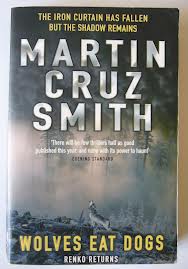
When people speak of bestselling author Martin Cruz Smith, they invariably mention Gorky Park, the first Arkady Renko novel, later a 1983 film starring William Hurt. Cruz Smith wrote other Renko novels: Polar Star, Havana Bay, Three Stations, but Wolves Eat Dogs, published 2004, is the pick of them all.

Famous New Russian Pasha Ivanov appears to have committed suicide by throwing himself through the window of his palatial, 10th floor apartment in Moscow. But is it suicide? Chief prosecutor Zurin wants to treat it as such. Arkady Renko, senior investigator in Zurin’s office, isn’t sure. When a search of the dead man’s apartment reveals a hill of salt in his clothes closet, despite the fact the high-security apartment’s staff swears there’s been no breach in security, he’s even more convinced something’s amiss.

Zurin orders Renko to close the file. But then, Ivanov’s NoviRus successor is found murdered at the entrance to the cemetery in Pripyat, a small village inside the Zone of Exclusion near Chernobyl. To keep the Ukrainian authorities happy, and to get rid of Renko, who won’t give up on the Ivanov case, Zurin sends Renko to Chernobyl.

Here, in the Zone of Exclusion, the radiation levels are 65 times normal; observation scientists work one month on, one month off, and many of the zone’s elderly inhabitants have returned secretly to live out the rest of their lives in the black villages around the reactor, growing their own vegetables, keeping pigs and cows as they’ve always done — they find it preferable to living out their days in a one-room basement apartment in Kiev.

After Renko arrives in the Zone, the novel really takes off, and Cruz Smith produces some of the best writing I’ve read in the crime/mystery genre. He gives a gut wrenching description of the last hours of Chernobyl’s doomed Reactor Four and of the errors in judgment that fed the disaster, and his evocation of the abandoned city of Pripyat, even closer to the reactors than Chernobyl, is haunting.

Chernobyl’s dark legacy will remain for 50,000 years, and its actual cost in human misery can never be accurately determined. As Cruz Smith says, ‘It depends on who’s counting’. Estimates vary from 41 dead (the Russians) to one million people adversely affected by radiation; the wind blew from Chernobyl to Kiev on May Day, five days after the disaster, yet the May Day march involving over 100,000, many of them schoolchildren, was not abandoned.

The novel’s odd and perhaps off-putting title is explained in the book’s following exchange:

‘Do any of you have dogs?’ [Arkady asked some of the women in a black village.]

‘No dogs,’ Klara said.

‘Wolves eat dogs,’ said Nina.

Don’t let the title put you off. It’s what Susan Geason, creator of the Australian Syd Fish detective series once described as ‘a real gem’.


Read Full Post »

During my latest stint of two weeks without a computer (the pedal-driven, twig and raffia monsters I work on have a habit of breaking down regularly), what with the rain coming down incessantly, I had recourse to a number of books in an effort to save my sanity. I read T C Boyles’ The Inner Circle, Norman Mailer’s Harlot’s Ghost (big books, both of them) Joe Orton’s Diaries (he was killed by his lover, remember?), Christopher Isherwood’s A Meeting by the River, and on and on. And on, anything to try to save my sanity. These books don’t reflect any pattern; I’m not a planned reader, I read anything I fall over or that people lend me. Being obsessive by nature, I dare not make a reading plan, find it wiser to keep myself open to whatever reading matter comes along.

The last book I read before the snowed tech finally got around to me was The Journals, Volume 1 by John Fowles, another big book, edited by Charles Drazin from the raw material of Fowles’ diaries, over two million words covering the period from 1949, when he was in his final year at Oxford, to 1965, when he’s wrestling with a lucrative offer from Fox Studios for The Magus.

Fowles, c. 1952

Fowles, c. 1952

These days, Fowles is well known for The Collector, The Magus, and The French Lieutenant’s Woman, all of which were made into films, but being unknown as a novelist myself, I found most interesting the period in which he was struggling and unrecognised. I thought other indie writers might enjoy reading a bit about this part of Fowles’ life too, so I’ve included a few lines from The Journals below:

25 August 1956

Halfway revising The Joker —  now The Magus. The construction is all right. But [there is] constant slipping down in technique; invasion of cliché. I have to treat each sentence drill-fashion. Is it necessary? Is it succinct? Is it clear? Is it elegant? Has it clichés? It usually has.

10 May 1958

Creation by effort; it is despised. What is admired is the ‘natural’ genius of the ‘born’ artist … myself … I seem to have endless obstacles to overcome — laziness, doubt, slowness, the cliché — so that if I finally achieve anything … it will be in spite of myself; self-taught, self-made. And no aid from the bloody muses.

About his poverty:

4 May 1958

Rent increase; already they take five guineas a week. Now it’s to be six. We shall have to leave. It’s too much to lose each week, even with E [his wife] working as she is now, fulltime …Poverty is now part of me … There is still very little I would (indeed could) do for money; but sometimes the strain rises above the surface of my acceptance. The great black wall to wall … poverty that we have had for the last four or five years; we swing from Friday [his payday as a schoolteacher] to Friday. Like squirrels on the run; it doesn‘t do to think of a branch or Friday giving way.

When he finally makes it with The Collector in 1962, you heave a sigh of relief. Some of the first things he buys are an overcoat and a suit for himself, an outfit for his wife, a secondhand camera, a coffee table and some secondhand chairs. Touching. (Though, upon reflection, you begin to wonder just how Fowles defined poverty when he and his wife were both working fulltime before his breakthrough, and they had no children. But let’s not ruin the story; perhaps the rent they were paying was exceptionally high for the times.)

For any writer out there who is currently struggling and unknown, the journals give a glimpse into the problems of a writer whom we all think of as having made it, and just a taste of his struggles AFTER he’s made it, the terrible script conferences where he tries to hold on to the integrity of his work in the face of Hollywood’s dollar worshipping producers.

The Volume 1 Journals end where he’s bought his place Underhill at Lyme Regis, and has just accepted Twentieth Century Fox’s offer for The Magus of $7,500 for the option, $92,500 on exercise of the option and $10,000 for a treatment. I couldn’t relate to those figures and, as I imagine Volume 2 will be his life after fame has hit him, I don’t think I’ll be taking it on. Still, Vol. 1 is an interesting read for struggling writers, and aficionados of Fowles.

Happy St Patrick’s Day, by the way.


Read Full Post »

« Newer Posts