Feeds:
Posts
Comments

Posts Tagged ‘Danielle de Valera’

Sunflower field at dawn

 What with the remaining cat’s veterinary bills, things are a bit tough financially, but they used to be tougher back around the turn of the millenium. At that time the local paper, the Byron Shire Echo decided to hold a competition for a short story of less than 1,000 words. The winning entry would receive publication in the Echo and prize money of $1,000. Needless to say, I decided to have a go. To my absolute surprise, I was lucky enough to win with “A Happily Married Man’, which told the story of a young man who thinks he’s had a message from God to eliminate the man his wife has left him for.

That was in 1997.

Next year, I decided to try again. This time I wrote about a single mother who’s life is threatened by a jilted lover with a shotgun. I called it “The State of Grace”, to try to explain the sense of calm that came over the her in the end, after she realises she is going to die. I didn’t hold out much hope for the story, but they were judged blind and to my amazement, I managed to win again. Now that’s what I call luck. It kind of made up for all those years of rejections. (I sometimes wish I’d kept my rejection slips; I really could’ve papered a wall with them.)

That was in 1998.

In 1999, Shelley Jackson of Lismore ran a fiction competition for women on the north coast of New South Wales. I was on a roll, so I tried again. The story I entered was called “The Sunflowers”. It was about a woman who’s been married for years to a husband who is physically abusive, but she won’t leave him. Finally, a particular incident involving gardening makes her decide to go. Again, I was lucky.

And there my remarkable streak of luck more or less ended. After that, I concentrated on writing novels and on getting stories published in magazines to improve my literary CV. In those days, you sent the publishers your novel extract by post, along with a pleading letter and what was called a literary CV. A good literary CV might sway editors in your favour. It seemed like a sensible idea to concentrate on this. As the song says, “Know when to fold’ em. Know when to walk away, Know when to run”.

Being only 1,000, 1,000 and 1,500 words respectively, the three stories described above were too short to publish separately on the web, so I’ve put them together in a bundle of 3,575 words called “Trio”. In the short story collection I’m hoping to put out in 2015, these three stories won’t run together as they do in “Trio”, but will appear separately in various places through the book. Anyone reading them to discover the fate of the four main characters in the collection (O’Neill, Johnson, Lawson and Star) needs to bear this in mind.

Trio” is FREE at Smashwords in three formats: EPUB, mobi (for Kindle) and pdf.

https://www.smashwords.com/books/view/492081

PS Many thanks to the people who’ve taken the trouble to review the stories I’ve put up so far. Reviews are necessary to sell anything on the web, so your kindness is very much appreciated.

A note on reviews:

Making life even more difficult for indie publishers, Amazon, the giant in this business, responsible for approximately 70% of all internet book sales, does not link its sites together where reviews are concerned. A review placed on the Australian Amazon site will not appear on the US Amazon site for the same book, or the UK’s —or any other Amazon site, for that matter. You would expect that one review would show up across all of Amazon’s sales sites, but it doesn’t. As it would be a dementing business for well wishers to copy and paste their reviews over all the sales sites, I would suggest placing your review where you think it will do the most good.

Read Full Post »

Real Thing-final(1)

One day in 1989, when I was struggling with the first draft of “Transference” (eventually published in Penthouse), my good friend and ex, Gianni Cosatto, strode into my house and plonked three handwritten foolscap pages down on the kitchen table.

“There you are,” he said. “I’ve written the first scene of a story for you.”

I picked up the pages and scanned them. The scene was written from the 1st person point of view. It seemed to concern a man who’s sent to a planet called Gerar to check the authenticity of a coin found there. As he sits in Reception, still shocked from the hyperspace, this gorgeous chick with long red hair comes out of an internal door and is rude to him. I gathered that rudeness was a turn-on for this hero, who immediately decides to fall in love with her. End of scene.

“What else happens?”I asked Gianni. “I mean, What’s the story?”

“Dunno,” said Gianni, “I just wrote the first scene. You’re the writer.”

“Well, thanks,” I told him. “I’ll have a crack at it later.” I might as well have said: I’ll bury it later. I had no intention of having a crack at it. I pleaded busyness whenever Gianni enquired about it in the years that followed.

One rainy day in the twenty-first century, long after Gianni had died, I found the story in a drawer and decided to try to finish it. Seductresses with long red hair didn’t interest me, so I made it a gay story. But it never really worked. Sci fi mags I submitted it to were put off by the gay relationship; mags that might’ve been interested in the relationship were put off by the sci-fi angle. I was stuck with it. One day, I realised that the the idea of finding a coin on Gerar or anywhere else, for that matter, was so preposterous a plot I might as well set the story in Australia. I chose Maralinga, with its interesting history of British A-bomb explosions in the late 1950s and early ‘60s.

So here it is. I’ve recently worked it over yet again to fit the Charles Lawson thread in the short story collection I’m building, tentatively entitled North Coast Stories. It’s 5,885 words long and available for 99 cents at:

http://www.amazon.com/dp/B00OQAB7UW

https://www.smashwords.com/books/view/485382

Whatever misgivings I might still entertain about the story’s far-fetched plot, I’m immensely happy with the cover, which author C S McClellan created from a recent photograph of Maralinga country by Baz Landy.

For those who are interested, below is a recap of where we’re up to now in the North Coast Stories collection:

  1. Busting God

http://www.amazon.com/dp/B00J8ZIE8S

https://www.smashwords.com/books/view/416303

  1. Remains to be Seen

http://www.amazon.com/dp/B00LNDWRM2

FREE at https://www.smashwords.com/books/view/454352

  1. Stella by Starlight

http://www.amazon.com/dp/B00MTVVG96

https://www.smashwords.com/books/view/467119

  1. Star’s Story

FREE at: https://www.smashwords.com/books/view/479505

  1. The Real Thing

http://www.amazon.com/dp/B00OQAB7UW

https://www.smashwords.com/books/view/485382


Read Full Post »

super moon in starry sky on sea


Nine years ago or thereabouts, the Australian Women’s Weekly ran a short story competition with a first prize of $5,000 and guaranteed publication in this most circulated of Australian women’s newspapers. Being a writer and thus financially on the rocks (I figure I’ve made about $8 a week from my writing over the last 20 years, and that’s a high-end estimate), I decided to enter. I didn’t expect to win, but I thought there’d probably be a short list and the stories on that would be offered publication. And the Women’s Weekly pays, baby, pays.

So I sat down and sweated out a story of 5,000 words and sent it off. Months passed. Eventually the result was announced, but Danny Margaret had scored zero, zilch, and there didn’t appear to be a short list. Well, I thought, so much for that, and I put the story away in the proverbial bottom drawer.

Five years went by. One day (I must’ve had nothing better to do, perhaps it was the wet season) I pulled the story out and reread it. It’s not bad, I thought. Very Women’s Weekly – what a shame it didn’t get anywhere … Then I remembered Australian writer Marele Day saying once in a writing workshop that magazines were always looking for Christmas stories. They were drowning in the other kind, she said; but they were always short of Christmas stories. Hmm, I thought.

At the time my finances were in worse-than-usual disarray. Publication in the WW would sort all that out. O-kay. There was just one hitch: My story wasn’t a Christmas story. To solve this problem, I had the main character’s daughter refer to Christmas in an already-existing phone conversation and I had two people the main character passes on her way to the beach wish her a Merry Christmas. That’s all I did.

By now, my CV had filled out, and I had a little more confidence than I’d had in earlier years. I approached the editor of the Women’s Weekly by email, gave her my CV and a 3-line synopsis of the story and asked if she’d be interested in reading my “Christmas story”. Next thing I know I’m being offered publication in their 2010 Christmas edition.

The moral of this monologue is: If you put a short story in a competition and it doesn’t get anywhere, that doesn’t mean anything. What matters is being published. Craig McGregor told me this way back in 1979, but I didn’t take any notice. Besides, being a single parent, I needed the money that comps could provide.

Now here is “Stella by Starlight” minus the Merry Christmases. I’ve also made one other change, transforming the main character from female to male, to fit the story into the collection I’m publishing next year. Everything else, though, is the same, and the theme and moral of the story are unchanged.

Sales points for “Stella” are below. I hope you enjoy it. I wish I could provide a direct sales link to Apple, but I’m digitally disadvantaged.

http://www.amazon.com/dp/B00MTVVG9C

https://www.smashwords.com/books/view/467119

Read Full Post »

P1000489(1)

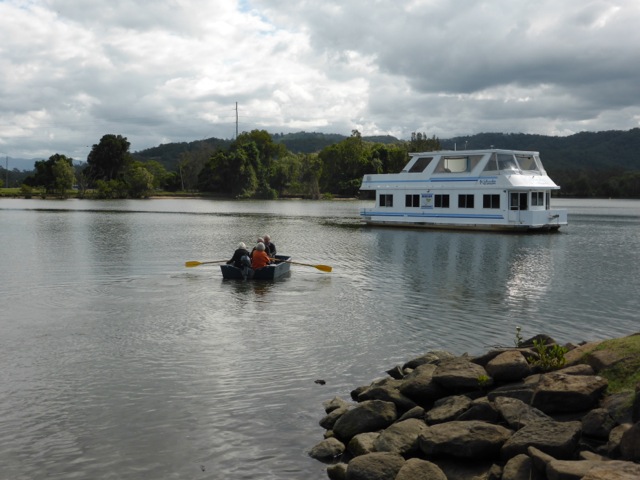
Astrologers tell me I was born with the moon in Pisces, which is supposed to explain my fondness for water and the fragile state of my mental health. Well, who knows? Anyway, perhaps that’s why I fell in love many years ago with the idea of a trip on a houseboat — not that I’m an intrepid sailor; I don’t know port from starboard, and though I can stay afloat in calm water, I can’t swim for nuts.

When it came my turn to organise the biennial get-together of a few old Ag Scientists and spouses (the operative word here is old; if you want to be politically correct elderly), I wondered what I would do. I live in a broom cupboard three hundred metres from the Pacific Ocean. Eight of us couldn’t stay there. What to do? Then I remembered my houseboat dream. l made enquiries. T’was possble: The rental for 4 days and nights was a little over $200 per person. This amount can be a lot or a little, depending on the state of your finances.

Off we went.

The first night one of my girlfriends and I spent a lot of time wandering the boat while everyone else slept. We were trying to uncover the source of various odd noises. Were we dragging the anchor? What was that strange banging noise we could hear upstairs? Had we dropped the anchor too short and the nose of the boat was slowly being pulled under the water as the tide rose? (My particular favourite.) Etc. etc. Eventually exhaustion overcame us and we slept. To put it in buddhist terms, we “wore the experience out, and so were able to relinquish it.” Whatever.

We had a bit of an accident on our first morning out. In attempting to get from the houseboat to the dinghy, one of our number fell into the river. But we fished him out and dried him off and gave him a cup of tea. Soon he was as good as new.

More adventures befell us. With me as navigator and our Fallen in the Water (FITW) skipper, we managed to run aground later on that day. Well, of course, what were you expecting? I have zero skills as a nav. In my defence I have to say that when we reached the point where we had to choose one waterway or the other, the green bouys I was following appeared equally relevant — or irrelevant, depending on how you were looking at it. It was just bad luck that decided me to tell our intrepid skipper to go right (starboard?) instead of left (port)?

“We need to rock the boat from side to side,” our FITW skipper told us. So we rushed to the upper deck and ran en masse from one side of the boat to the other while he revved the engine below. We were lucky: We were able tto reverse off the sandbank without having to submit to the shame of being towed off, or whatever it is they do under those circumstances.

We managed to get into and out of the dinghy without further mishaps.

 P1000498


Here we’re returning from lunch at the Tumbulgum Pub; I’m the one in the orange pullover, clinging white-knuckled to the gunwale. Note to those in the Northern Rivers: The food at the pub was OK, but if you want ambience and nice food, skip the pub and go the the little Birdwing Cafe down the road.

With a little help from our friends, we got to the Tweed River Art Gallery to see the new installation: a recreation of some of the rooms in recently-deceased artist Margaret Olley’s terrace house in Sydney. Olley was famous for her house, which was a mix of objets d’art, paintings and clutter.

 Margaret Olley


It was a good trip. The weather held fine, the Tweed lived up to expectations — it’s a beautiful river and there was very little traffic on it while we were there. Evenings as the boat swung at anchor, the stars seemed to wheel slowly across the night sky, and the moon slipped in and out of view in the windows of the room where I was sleeping.

If you’ve never had a trip on a houseboat, think about trying it sometime. It’s different.

[Photos of the Tweed and the “Kalinda” by Dr Martin Playne. ]


Read Full Post »

Novel under const'n

 A few days ago I was surprised to receive an email from Carol Middleton, an Australian award-winning writer, and a reviewer for the prestigious Australian Book Review. In the email Carol invited me to join the Writing Process Blog Tour, in which writers are invited to reply to four questions about their writing process and then pass the baton on to another writer/s.

Many thanks to Carol for inviting me to contribute to this tour, which in its construction is like a chain letter but nice. You can see Carol’s Writing-Process Blog published Monday 12th at http://carolmiddleton.com.au/wordpress

Here goes.


What am I working on?

Having put my first novel out on Amazon and Smashwords last year, I decided to try to get myself a bigger presence on the web by putting up a short story a month in 2014. Being the digital klutz that I am, it took me three months to learn enough to put up my first story Busting God, now available at: www.amazon.com/dp/B00J8ZIE8S. I’m now working on formatting my second story Remains to be Seen, which follows the fortunes of Busting God’s hero as he tries to recover from the post-traumatic stress caused by his participation in the Vietnam War.

I’m a tortoise, very slow at everything I do, and not very comfortable on the web. However, I’ve decided that having a higher profile there will help my novels eventually, so I’m nailed to the cross of formatting these twelve short stories for the remainder of 2014.

How does my work differ from others of its genre?

How to answer this question? My short stories were published in such diverse places, ranging from Penthouse to Aurealis to the Australian Women’s Weekly. Each time I adapted my basic writing style to suit the market — I was a single parent and I needed the money. My only novel published so far is MagnifiCat: www.amazon.com/dp/B00H0ORWQY a strange little animal fantasy about a family of cats who find themselves on the poverty line in a small country town in New South Wales, Australia. In it I aimed to produce a kind of Wind in the Willows for adults. To what extent I succeeded is hard to gauge. The novel’s definitely not satire; it’s more like a fairy tale for adults, with an underlying heavy core that makes it adult fiction, though I plan to release a children’s version of it in 2015, minus the alcohol and the angst.

Why do I write what I do?

In my case there are two answers to this. The short stories were written either for money — publication or competition money — or to add to my literary CV. In the novels, however, I get to please myself. And I notice that what comes though in all of them (I have another four in various stage of development) is a desire to nail down a particular time and place that’s now long gone. You could say I’m obsessed with transience, and writing about these places is my way of trying to keep them alive in people’s memories after they’ve disappeared under the bulldozer of progress. My Queensland novel is set in Brisbane in the early 1960s; MagnifiCat is set in Byron Shire in the mid-1980s, and somewhere in the dim future, should I live that long, I’d like to write a novel set in Brisbane during WWII. It’s as if I’m saying to readers, Remember how it was. Don’t forget this.

How does my writing process work?

I write first draft material in the morning, while I still have some contact with my unconscious. Editing, a completely different process requiring a different part of the brain, I can do any time. I never work after dark unless I have an editing job or a manuscript appraisal for another writer and the deadline is looming.

To me, producing first-draft material is like digging semi-precious stones out of the ground, while editing is like polishing those stones into something people might find beautiful or useful. Basically, I want my writing to entertain, to make people happy. At the risk of sounding overly ambitious (or merely quaint), I’d like it to give people hope. Life can be tough sometimes.


The writer I’ve asked to continue the Writing Process Blog Tour on Monday 26th is Ed Griffin, a Canadian novelist and prison reformer. Ed taught creative writing in prisons for many years. He blogs at:

prisonuncensored.wordpress.com

Check him out on Monday 26th.


Read Full Post »

« Newer Posts