Feeds:
Posts
Comments

P1000489(1)

Astrologers tell me I was born with the moon in Pisces, which is supposed to explain my fondness for water and the fragile state of my mental health. Well, who knows? Anyway, perhaps that’s why I fell in love many years ago with the idea of a trip on a houseboat — not that I’m an intrepid sailor; I don’t know port from starboard, and though I can stay afloat in calm water, I can’t swim for nuts.

When it came my turn to organise the biennial get-together of a few old Ag Scientists and spouses (the operative word here is old; if you want to be politically correct elderly), I wondered what I would do. I live in a broom cupboard three hundred metres from the Pacific Ocean. Eight of us couldn’t stay there. What to do? Then I remembered my houseboat dream. l made enquiries. T’was possble: The rental for 4 days and nights was a little over $200 per person. This amount can be a lot or a little, depending on the state of your finances.

Off we went.

The first night one of my girlfriends and I spent a lot of time wandering the boat while everyone else slept. We were trying to uncover the source of various odd noises. Were we dragging the anchor? What was that strange banging noise we could hear upstairs? Had we dropped the anchor too short and the nose of the boat was slowly being pulled under the water as the tide rose? (My particular favourite.) Etc. etc. Eventually exhaustion overcame us and we slept. To put it in buddhist terms, we “wore the experience out, and so were able to relinquish it.” Whatever.

We had a bit of an accident on our first morning out. In attempting to get from the houseboat to the dinghy, one of our number fell into the river. But we fished him out and dried him off and gave him a cup of tea. Soon he was as good as new.

More adventures befell us. With me as navigator and our Fallen in the Water (FITW) skipper, we managed to run aground later on that day. Well, of course, what were you expecting? I have zero skills as a nav. In my defence I have to say that when we reached the point where we had to choose one waterway or the other, the green bouys I was following appeared equally relevant — or irrelevant, depending on how you were looking at it. It was just bad luck that decided me to tell our intrepid skipper to go right (starboard?) instead of left (port)?

“We need to rock the boat from side to side,” our FITW skipper told us. So we rushed to the upper deck and ran en masse from one side of the boat to the other while he revved the engine below. We were lucky: We were able tto reverse off the sandbank without having to submit to the shame of being towed off, or whatever it is they do under those circumstances.

We managed to get into and out of the dinghy without further mishaps.
 P1000498


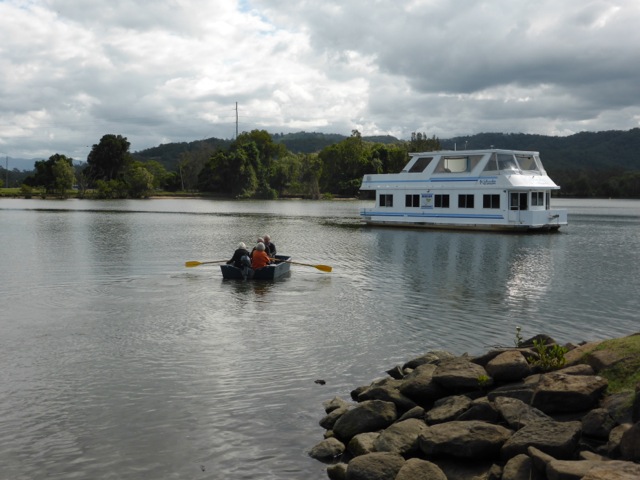
Here we’re returning from lunch at the Tumbulgum Pub; I’m the one in the orange pullover, clinging white-knuckled to the gunwale. Note to those in the Northern Rivers: The food at the pub was OK, but if you want ambience and nice food, skip the pub and go the the little Birdwing Cafe down the road.

With a little help from our friends, we got to the Tweed River Art Gallery to see the new installation: a recreation of some of the rooms in recently-deceased artist Margaret Olley’s terrace house in Sydney. Olley was famous for her house, which was a mix of objets d’art, paintings and clutter.

 Margaret Olley


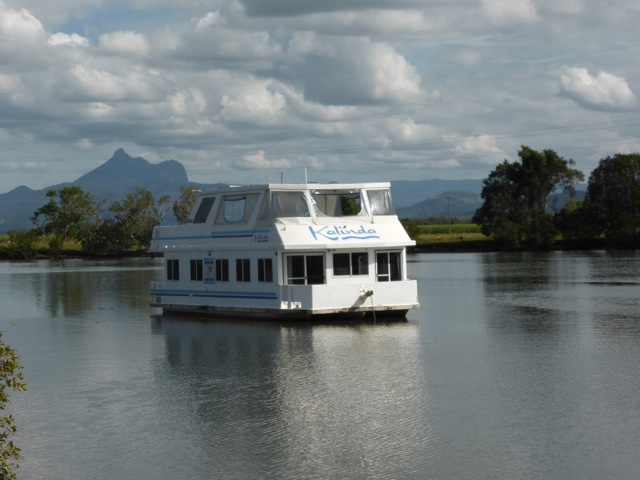
It was a good trip. The weather held fine, the Tweed lived up to expectations — it’s a beautiful river and there was very little traffic on it while we were there. Evenings as the boat swung at anchor, the stars seemed to wheel slowly across the night sky, and the moon slipped in and out of view in the windows of the room where I was sleeping.

If you’ve never had a trip on a houseboat, think about trying it sometime. It’s different.

[Photos of the Tweed and the “Kalinda” by Dr Martin Playne. ]


Novel under const'n

 A few days ago I was surprised to receive an email from Carol Middleton, an Australian award-winning writer, and a reviewer for the prestigious Australian Book Review. In the email Carol invited me to join the Writing Process Blog Tour, in which writers are invited to reply to four questions about their writing process and then pass the baton on to another writer/s.

Many thanks to Carol for inviting me to contribute to this tour, which in its construction is like a chain letter but nice. You can see Carol’s Writing-Process Blog published Monday 12th at http://carolmiddleton.com.au/wordpress

Here goes.


What am I working on?

Having put my first novel out on Amazon and Smashwords last year, I decided to try to get myself a bigger presence on the web by putting up a short story a month in 2014. Being the digital klutz that I am, it took me three months to learn enough to put up my first story Busting God, now available at: www.amazon.com/dp/B00J8ZIE8S. I’m now working on formatting my second story Remains to be Seen, which follows the fortunes of Busting God’s hero as he tries to recover from the post-traumatic stress caused by his participation in the Vietnam War.

I’m a tortoise, very slow at everything I do, and not very comfortable on the web. However, I’ve decided that having a higher profile there will help my novels eventually, so I’m nailed to the cross of formatting these twelve short stories for the remainder of 2014.

How does my work differ from others of its genre?

How to answer this question? My short stories were published in such diverse places, ranging from Penthouse to Aurealis to the Australian Women’s Weekly. Each time I adapted my basic writing style to suit the market — I was a single parent and I needed the money. My only novel published so far is MagnifiCat: www.amazon.com/dp/B00H0ORWQY a strange little animal fantasy about a family of cats who find themselves on the poverty line in a small country town in New South Wales, Australia. In it I aimed to produce a kind of Wind in the Willows for adults. To what extent I succeeded is hard to gauge. The novel’s definitely not satire; it’s more like a fairy tale for adults, with an underlying heavy core that makes it adult fiction, though I plan to release a children’s version of it in 2015, minus the alcohol and the angst.

Why do I write what I do?

In my case there are two answers to this. The short stories were written either for money — publication or competition money — or to add to my literary CV. In the novels, however, I get to please myself. And I notice that what comes though in all of them (I have another four in various stage of development) is a desire to nail down a particular time and place that’s now long gone. You could say I’m obsessed with transience, and writing about these places is my way of trying to keep them alive in people’s memories after they’ve disappeared under the bulldozer of progress. My Queensland novel is set in Brisbane in the early 1960s; MagnifiCat is set in Byron Shire in the mid-1980s, and somewhere in the dim future, should I live that long, I’d like to write a novel set in Brisbane during WWII. It’s as if I’m saying to readers, Remember how it was. Don’t forget this.

How does my writing process work?

I write first draft material in the morning, while I still have some contact with my unconscious. Editing, a completely different process requiring a different part of the brain, I can do any time. I never work after dark unless I have an editing job or a manuscript appraisal for another writer and the deadline is looming.

To me, producing first-draft material is like digging semi-precious stones out of the ground, while editing is like polishing those stones into something people might find beautiful or useful. Basically, I want my writing to entertain, to make people happy. At the risk of sounding overly ambitious (or merely quaint), I’d like it to give people hope. Life can be tough sometimes.


The writer I’ve asked to continue the Writing Process Blog Tour on Monday 26th is Ed Griffin, a Canadian novelist and prison reformer. Ed taught creative writing in prisons for many years. He blogs at:

prisonuncensored.wordpress.com

Check him out on Monday 26th.


bustinggod(2)

A long, long time ago, back in the early ‘90s, I had my first short story published in a national magazine. My children and I were over the moon: the money (AU$1,500) was astronomical in those days. A few years later, I decided to see if I could crack the same market again—after all, $1,500 never goes astray.

I’d just read Narc! Inside the Australian Bureau of Narcotics by Bernard Delaney, who was a senior investigator in the narcotics bureau for some years before becoming Commander for the Southern Region of Australia. So I wrote this 5,000 word short story about an undercover narcotics agent, basing the procedures on Delaney’s book. After the usual eight drafts, I submitted it to the editor who’d accepted my previous story. My timing was bad. A week after I submitted the story, the magazine was sued for defamation. In the chaos that ensued, ‘Busting God’ went nowhere. I put it away and concentrated on the next draft of my Brisbane novel. Some twenty years later, I sent the story to an Australian magazine called Blue Crow, edited by Andrew Scobie, who accepted it enthusiastically.

Now that I‘ve decided to put all my work up online before I fall off the perch (it seems safer than wrapping it in ‘fireproof’ material and putting it in the tin trunk, but I might be wrong), I gave the story yet another draft and put it up on Amazon and Smashwords. In brief, it’s the story of an aging undercover agent who, along with his long-time Vietnam buddy Baby Johnson, is sent to the Northern Rivers of New South Wales to bust a heroin dealer everyone up there calls God because he’s so big. Apart from successfully running God to earth, the major conflict in the story takes place in the hero’s head. Will he stay in law enforcement or get out before his slowing reflexes get him killed? That’s the main idea behind the story, and the idea that leads to the next story I’m putting up in three weeks time, this time for free, called ‘Remains to be Seen’. As part of my plan to try to save the work before I drop off the perch, I plan to put up another eleven stories on the web this year, half of them for sale, half for free. This one has a price on it, but I chose the lowest price both sales sites would allow.

‘Busting God’ is one of the three favourite stories I’ve written; there’s a lot of tongue-in-cheek humour. It’s also the first thing I’ve ever formatted. Being the digital klutz that I am (oh yes, I am — see my previous post on this subject at: https://danielledevalera.wordpress.com/2013/09/17/for-all-you-luddites-out-there/, formatting that story took me a long time and I’m so chuffed that I managed to do it. I was further encouraged by fellow writer C S McClellan, who did the you-beaut cover for me. Thank you so much, Connie; designing an ebook cover is way out of my league.

If you’ve got a moment or so, pop over and take a look at ‘Busting God’. You can read about 30% for free at either:

https://www.smashwords.com/books/view/416303

or www.amazon.com/dp/B00J8ZIE8S

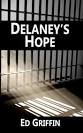
Internet friend Ed Griffin continues his run of prison reform novels with Delaney’s Hope, an upbeat idea for a new kind of prison.

Delaney's Hope coveAvailable at: http://www.amazon.com/Delaneys-Hope-Ed-Griffin-ebook/dp/B00GFGEBMG

In this guest blog Ed talks about the wellsprings of his hope for reforms and the novels in which he’s put forward these ideas.

Ed Griffin:

I am interested in prison reform. This is a direct result of teaching writing in prison for twenty years. It’s an indirect result of my education and service as a Roman Catholic priest for five and a half years. I heard the message of the gospel that we were to care for the “least of the brethren.” In my opinion, there wasn’t anybody more least in our society than a federal inmate.

I left the priesthood a few years after marching in Selma with Doctor Martin Luther King. That’s another story, relayed in my non-fiction book, Once A Priest.

I’ve written a lot about prison reform. My first novel, Prisoners of the Williwaw, is a story about Frank Villa, who convinces the US Government to put 300 hardened convicts on an island with their families and let them rule themselves. The federal government has finally realized that they can’t keep paying for prisons. Right now it costs $100 a day to keep a man in prison. So they let Frank Villa have an abandoned Naval base on the island of Adak in the Aleutians. No guards will be on the island, but the US Coast Guard will patrol the waters around Adak, and they will shoot to kill.

Half way to Russia and caught between the Pacific Ocean and the Bering Sea, it rains and snows 85% of the time on Adak. In addition, a fierce wind called a Williwaw builds up behind the mountains and smashes down on houses, equipment and even children. In World War II, the weather killed more soldiers than the enemy did.

Frank also faces a convict who plans to use this situation to his own advantage. He knows that each convict leaves prison with $200. He’s eager to help them spend it.

Can convicts rule themselves? This is an issue the novel looks into.

My second book about prison is non-fiction. It’s called Dystopia. An inmate in my writing class joined me in telling the story of prison. We each wrote our stories, not in lesson form, but by relaying the stories of the men we met there.

I told why I came to teach in prison, despite my wife’s worry. Then I started with my first scary day and told about all the people I met in my class. One of the most amazing people I met was Mike Oulton. He’d been arrested in Mexico for trying to smuggle cocaine into the United States. His sentence was ten years, two of which he spent in a Mexican prison and eight of which he spent in a Canadian prison. Mike also tells stories of the men and the staff he met in all those years, and he hints at which prison system he liked better. Mike’s been out now for seven years and he’s doing well. He works as an MC and as a master of ceremonies for weddings. This is right in line with Mike’s whole life, but now he’s found legitimate ways to express his exuberant personality.

The third book about prison reform is my latest novel, Delaney’s Hope. Delaney is a prison official who put his feet up for twenty years. He tried at the beginning to make changes, but his superiors stepped on him, and so, he did nothing. But then his missionary brother died for standing up to the oil people who wanted to take his parishioners’ land. Delaney feels guilty about wasting all those years, and he tries to repent by setting up a prison that really works. He convinces the government to let him use an abandoned minimum security prison in Wisconsin.

At the beginning he will only have five prisoners and three staff, counting himself. The criminal history of each inmate is given, as well as a picture of the staff. Delaney tries to break down the ‘us and them’ that exist in every prison. He tries to show the inmates that we are all weak human beings and no one, including the staff, is perfect.

His inmates include a drug smuggler who tries to sabotage everything Delaney tries to do. Another man killed his wife in front of their son. A third inmate ran a commercial greenhouse and cheated on the rules. That might have been okay, but then he knocked an old man out of tree, a neighbor who opposed his plans. The old man died. A sheriff who wanted this land to build a big maximum security prison convinced a sex offender to come to the prison, where he presented Delaney with a lot of problems.

Another thing Delaney tries to deal with is the sexism of prisons. Yes, what we now mean by a male prison is not a place for women, but Delaney points out that almost all of society is mixed male and female. If he can create a calm atmosphere, there is no reason why male and female inmates can’t be integrated at least as far as programs are concerned.

The prison starts and Delaney faces problem after problem after problem. Will it work? Can a prison work that’s not like what we have today?

Prison reform is not a popular subject, but we need to face it. When we hear that California spends more money on prisons than it does on education, we begin to ask questions. When we hear that the United States is one of the countries with the most prisoners, it’s time to look at prison reform. And Canada now with its conservative government tries to win votes on the backs of inmates. Right-minded people do not agree.

I hope my two novels and one non-fiction book about prison reform will have an impact. When I started to write, I promised myself I would never bore the reader; I would show, not tell; I would not let one word of opinion enter the story. I hope I have succeeded.

Ed Griffin

Quadcopter

Quadcopter

If you live in Australia, watch out for umanned aerial vehicles (UAVs) when you’re out in the open. My girlfriend and I encountered one last Saturday at Boulder Beach, a little-known beach north of Ballina in New South Wales. This beach is something of an oddity; it’s very different from the sandy beaches of the rest of northern NSW. It’s literally covered in small boulders, washed smooth by the sea.


Boulder Beach

It was lunchtime, we spread out a blanket and had a picnic under a breadfruit tree. After we’d eaten, we went out some 300 metres to paddle in the rock pools left behind at low tide. It was a beautiful day, hardly a cloud in the sky. As we were rolling up our jeans to wade a bit in one of the larger pools, we heard a sound that didn’t fit in this idyllic seascape. A mechanical sound. Into our line of vision came buzzing an unmanned quadcopter about three feet in diameter, all black metal, flying at a height of around 30 feet. Unnoticed by us, some guy in a van had pulled up onshore and launched this UAV, which he kept in our vicinity, the red light of its camera pointing at us. He had the entire empty beach to fly it in but he kept it near  us. It seemed to be a deliberate provocation. We suspected we were being photographed so we didn’t react.

If I’d had a slingshot I might’ve brought it down, but slingshots are illegal in Australia, while anyone can buy a UAV and you don’t need a licence to fly one. There’s so much concern about the increasing use of these drone UAVs the Australian government recently convened a special senate commitee hearing on the subject. The upshot of it was that at present there are no privacy laws in Australia covering the operation of drones in open spaces; only safety concerns can legally be addressed. The Australian Civil Aviation Authority CASA’s ruling is that a UAV must never be closer than 90 feet to any member of the public. This guy’s was around 30 feet.

After five minutes of so we tired of this passive aggression and began to return to shore. The operator brought the drone back in. Although he was standing one metre away from where we’d left our picnic blanket and gear — an unusual thing in itself to do when he had the whole beach to choose from — he never spoke to us when we returned, never made eye contact, though he kept the front of the landed drone facing us and its red camera light remained on.

What do you do in a situation like that? You have no legal rights. If you attack him or damage his drone (the high-end ones can cost well over a thousand dolars), you’ll be the one who ends up in court. If I’d known at the time about the CASA ruling of 90 feet, I might’ve spoken to him; then again, I might not have – I try to steer clear of loonies, especially ones I don’t know and whose behaviour I can’t predict.

I wondered if he had a little online site tucked away somewhere where he put up footage of the women he’d aggressed, or was it just a private kick? This middleaged guy with glasses didn’t look to me as if he’d be game to fly it over any men, unless perhaps they were on crutches. Using the rego number of his van, I found he’d registered with a UAV site in the US on 17 December 2012, so I’m sure we’re not the first women he’s pestered.

The moral of this story is: next time you’re out in the open in Australia and think you’re alone, think again. Some passive-aggresive stalker three hundred metres distant could be sending a drone your way.

Ah, brave new world.

Danielle

HorseI’m one of those people who believes in everything and nothing, so don’t take it amiss that I share a few thoughts with you at the beginning of this Year of the Wooden Horse. The book I’ve got on Chinese astrology (someone less able than I to accommodate ambivalence gave it to me) says horses always look terrific, have plenty of sex appeal and know how to dress, but that they’re also hotheaded, hotblooded and impatient. In the years when I was younger and used to give Chinese New Year’s Eve parties, there must have been a few horses among the crowd. If there were, I don’t remember them, so I can’t pass judgment on the accuracy of the book, but we sure had a lot of fun passing it around and guffawing at the descriptions.

But I digress. What I’m really here for is to wish all those who read this post the best of luck in the coming year. If, like me, you’re just starting out on the digital journey, my commiserations.

My goal, this year, is to release a dozen short stories, roughly one a month, ranging in length from 4,000 to 9,000 words, half of which are set in the Northern Rivers of New South Wales, Australia, an area I’ve lived in for the past thirty years and am still desperately in love with. I’m lucky enough to have a friend I met through this blog who is designing the first cover, but after that, I’ll be on my own in the formatting of both cover and story text.

Just how I’m going to manage, I have absolutely no idea. Designing the Smashwords versions of the stories won’t present many problems, thanks to the beautifully clear instructions in Mark Coker’s (Mark is CEO of Smashwords) Style Guide, obtainable free on the internet. Designing a Kindle version, however, is going to be more difficult. Both Smashwords and Kindle Direct Publishing (KDP) offer simple, pain-free translations of documents  from Word to Kindle, but what I’ve seen of the results doesn’t enchant me. However, whether I’ll ever be able to learn enough digitally to do better remains to be seen.

In short, just learning enough to put up those dozen stories in one form or another is my goal for the year. Wish me luck, everyone – and if anyone wants to tell me their goals for this Year of the Horse, I’m a good listener.

Horse drawing

Good luck to you all!

Dani

A Farewell to Ron

 The Kid

As 2013 draws to a close I find myself thinking more and more about my neighbour Ron, who passed away in October of this year after a long battle with cancer. We lived across from one another for over 13 years and, although we were never in and out of one another’s places (we would’ve hated that), we were there for one another. He was a single parent. When he first moved in, he had a boy who’d just started high school — a wild boy.

A number of years ago, when Ron was still well and I didn’t even know he had cancer, I went over to his place one day for coffee, and he told me his story, how he’d been given less than five years to live and how he’d decided he couldn’t die because no one else would be able to raise his son, whom he called ‘the kid’.

Ron was a born storyteller. The whole story rolled off his tongue and when I came home I simply wrote it down, just the way he’d told it to me. I’ve never done that before or since; I’m not that kind of writer. Later, when I wanted to enter the story in a fiction competition based around the subject of cancer, I added an extra frisson by having the narrator say she’d been on her way to commit suicide and the story of Ron’s courage had stopped her. The story ended up being short-listed in the Cancer Council of Victoria’s short story competition and included in an exhibition of art, poetry and stories, fiction and non-fiction, that toured country Victoria in (I think) 2009.

Ron was stoked to see his story in print. He was one of those unsung heroes who live and die unnoticed by the world, known only to a few friends and family. As his illness progressed, I saw a bit more of him, making him a baked dinner on Sundays when I made my own, but leaving him in peace to eat it in his own time. He had a miniature fox terrier named Bella, and even when things became difficult for him and he was on heavy doses of morphine, we would still see him walking Bella, growing thinner and thinner every week. He used to say, “She’s been so good for me. I wouldn’t get out and walk if it wasn’t for her.”

If you haven’t already done so, you can read Ron’s story FREE at http://www.derekhaines.ch/vandal/2013/11/short-story-the-kid-by-danielle-de-valera/

Remember, though, I’m a fiction writer: I was never a widow, nor am I contemplating suicide. (I left that behind with my youth.) The great part about the story is the real-life ending. Although given only five years to live, Ron lived to see his son all grown up with a kid of his own who promises to be every bit as much a tiger as he was. Life goes on.

The best of everything to you all for the New Year. May we be safe and well in 2014. (Wealth is good, but health is even better.)

Danielle

Christmas is here again, whether we like it or not. And whether we like it or not, it’s wise to remember it will soon be over – as will most other things.  So hold your loved ones near to you, tell them you love them. Cherish the good times, don’t dwell on the bad. And remember that kindness is like water in the desert to a stranger – to anyone, really.  We all need kindness.

Have a safe and happy New Year, everyone!

Danny's Christmas Tree

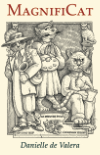
MagnifiCat_Cover_for_Kindle

Anyone taking a casual look at the novel I’ve just put up on the web might be forgiven for thinking I need therapy.

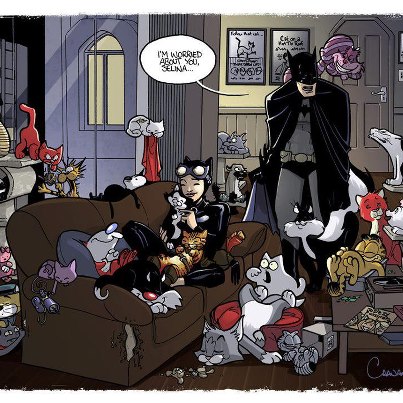
Cat CartoonBut though the cats have the spotlight, many other Australian animals feature in this fantasy for adults — a porcupine policeman, a python bank manager, a kangaroo in the milk delivery business, etc. etc.

Aside from all the animals, though, that slide, hop, glide through this novel, and despite my determinedly lighthearted approach, the book’s theme of life below the poverty line gives it gravitas. It’s not as innocuous as it seems.

But enuff about the novel. Maybe it’s merely a drop in the digital ocean, but because I’m such a klutz digitally, I’m just happy to have survived the experience of getting it up there.

Take a look. It’s available in both e and print form. It’s certainly unusual.

http://www.amazon.com/dp/B00H0ORWQY

DSCF3566

In the bush outside Casino, musing on the vagaries of life, and human nature in general, accompanied by two bovine mums. The new calves are just out of the frame.

 Last week I went to Casino to celebrate the Melbourne Cup with friends. For those of you who don’t know about the Cup, it’s the foremost horse race in Australia; everything stops for it. I don’t know one horse from another, but it’s good to catch up with old friends and see what improvements they’ve made on their 240 acres since I was last there.

I had another reason to be glad I was in the bush for a few days: the first morning I was there I received an email from the POD designer – she’s holding my book to ransom until she receives the remainder of her fee. Which is not a lot, I might add. This is unusual in the industry, thank the Lord – the e book designer sent me 3 different versions of my novel and an invoice the next day with a month to pay.( I paid him 48 hours later – I have figured out how to use PayPal.)

The print book designer and I have had a rocky time (we were both starting out). So, as I say, I was happy I was among friends when I received the email confirming what I already suspected but couldn’t bring myself to believe.

My November deadline, has perforce, moved to 11 December — too late for anyone wanting to buy hard copies for Christmas, unless they’re prepared to ship the book using Amazon’s exorbitant Priority Paid option.

Along with the ultimatum, the designer gave me her bank details. Alas, I haven’t yet learned how to pay someone overseas in this way, where, I understand, certain extra bits of arcane information are required. It was on my To do list, but what with editing and proofing the novel, it got pushed to the back burner. Into the nearest town that has a branch of my bank, obtain a bank cheque, and send it by registered post. It will take at least 10 days to reach the US.

When the designer has received the money and sends me the POD version (hope hope hope), it would be madness to go to press without seeing the proof. (We’ve been though two, so far.) Even using Amazon’s priority paid shipping option, I will lose another 6 days. If there are formatting errors that require fixing, I wonder what happens then?

Even if the book is ready to go, and I sure hope it is, I will lose another six days while I wait for the last lot of print copies to arrive. In my youth, I would’ve lost a lot of sleep over this. Now I just chalk it up to the aforesaid vagaries of human nature and move the date to 11 December. Just to be on the safe side.

It’s a weird situation, and I have no feelings against the designer. It’s not her fault I haven’t yet conquered overseas internet banking. And she did have a hard time with me, I know that. Remember, I’m the one who didn’t even know how to save attached files forwarded to me as downloads. (I thought you saved them under View, and wondered why I couldn’t print or forward them to anyone.) In my defence, though, I had a bit of a hard time myself. When you’re both learning, these things happen.

Life’s funny, and far too short to waste a lot of emotion on a thing like this. It’s very small hiccup in the overall scheme of things. It’s even funny, if you can just see the humour. Fancy being so awful that someone felt driven to this measure. It’s a kind of distinction, I suppose, but one I could well do without.

Darth Vader image

Come over to the dark side, Luke, with me and Danielle de Valera.